

Working principle
The double-effect evaporator is also called a two-effect evaporator. Its working principle is to use the secondary steam generated by the first evaporator as a heating source again and introduce it into another evaporator. As long as the pressure in the evaporator and the boiling point of the solution are controlled to appropriately reduce them, the secondary steam generated by the first evaporator can be used for heating. The secondary steam condensation point of the first evaporator is the heating point of the second evaporator. This is the principle of double-effect evaporation. Generally speaking: single-effect evaporation consumes 1.1~1.2 tons of steam per ton of water, and double-effect evaporation consumes 0.6~0.7 tons of steam per ton of water.
Scope of application
Double-effect evaporator is suitable for evaporation, concentration and crystallization of crystalline, high-concentration, high-viscosity solutions in chemical, pharmaceutical, printing and dyeing, environmental engineering, waste liquid evaporation recovery and other industries. It is usually used in chemical industry, light industry, food, medicine and other industrial production, such as the production and preparation of ammonium nitrate, caustic soda, antibiotics, sugar and fresh water preparation. It is also often used in industrial wastewater treatment in chemical industry, pharmaceutical, metallurgy, mining, petrochemical, rare earth, lithium battery, hazardous waste and other industries.
Process flow
The double-effect evaporator process can be divided into three forms: downstream, counter-flow and advection according to the series connection method according to the different flow directions of heating steam and materials. The selection of double-effect evaporation process is mainly based on the characteristics of the material.
System composition
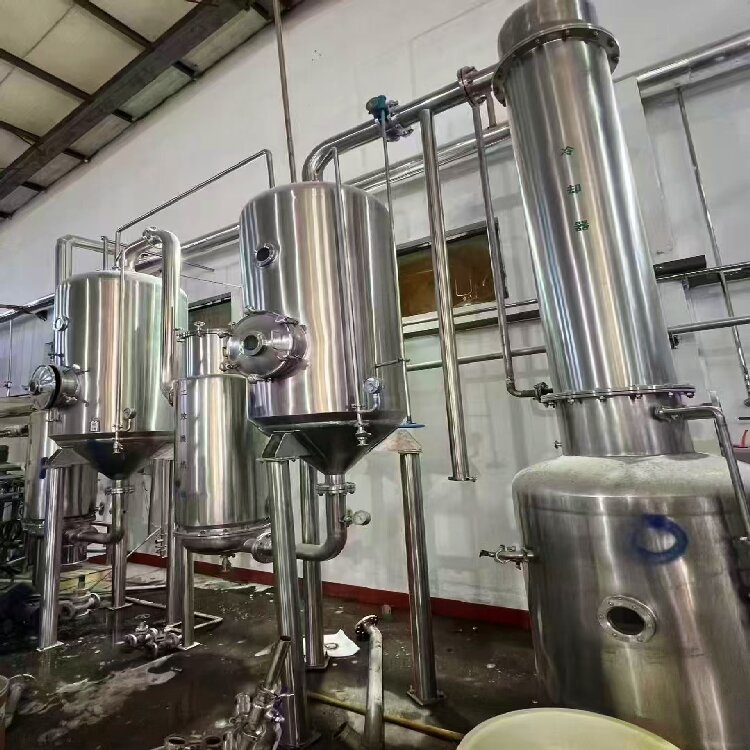
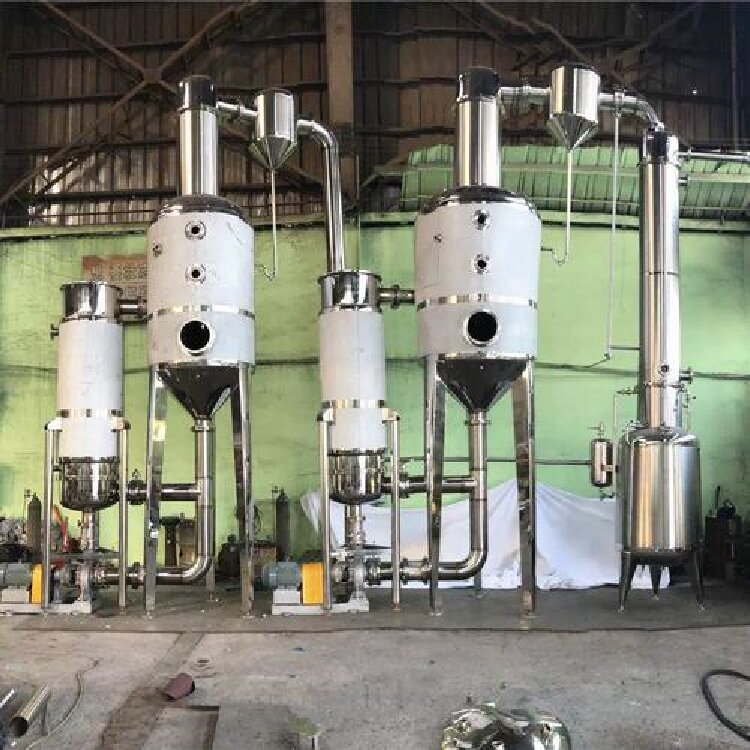
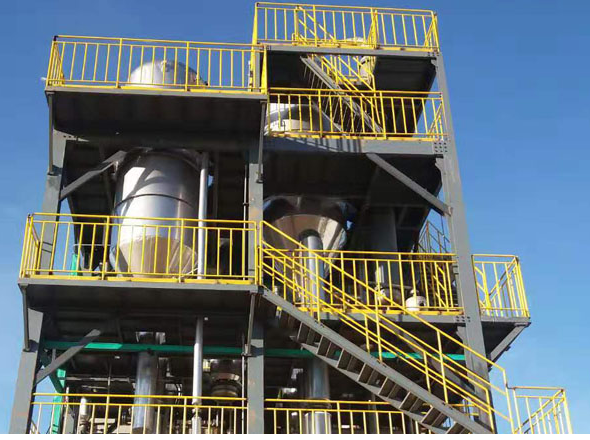
Double-effect evaporator consists of: heating evaporator, separator, condenser, circulation pump, insulation pipe, vacuum system, material and liquid transfer pump, condensation and drainage pump, operating platform, electrical instrument control cabinet, valves, pipelines and other systems.
Features
The double-effect evaporator is a new type of low-consumption, energy-saving vacuum evaporation and concentration equipment. Its characteristics are:
1. The equipment has the advantages of energy saving and consumption reduction, low steam consumption and low cooling water circulation;
2. The equipment can be equipped with a CIP cleaning system to achieve on-site cleaning. The entire equipment is easy to operate and has no dead ends;
3. The equipment continuously feeds in and out materials;
4. The equipment can be equipped with an automation system to realize automatic control of the feed volume, automatic control of heating temperature, automatic control of discharge concentration, automatic control of cleaning. It can also be equipped with automatic operations and controls such as protection measures for materials during sudden power outages and failures, as well as alarms.
Hot Tags: Double effect evaporation system Double effect evaporation device Double effect evaporator