

Overview
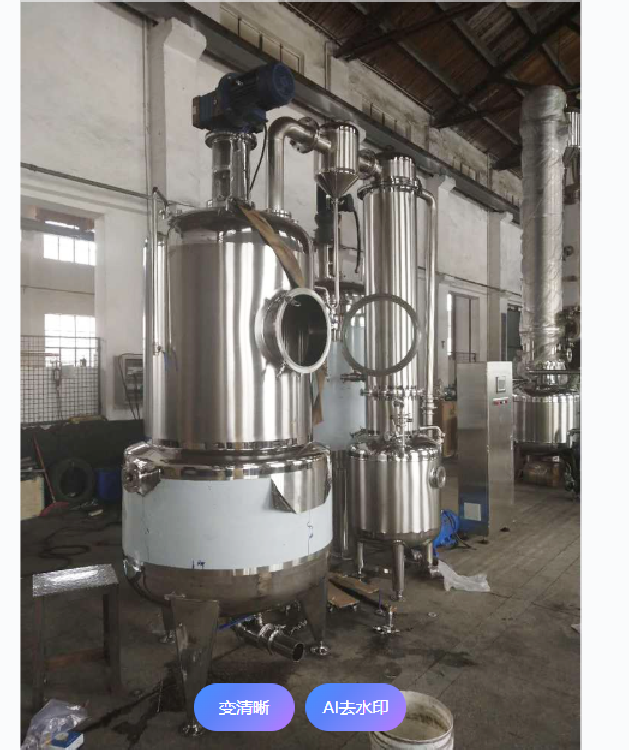
A single-effect evaporator generally refers to a single independent evaporator. The secondary steam generated when evaporating a solution is no longer used, and is suitable for the evaporation of small-scale solutions.
In large-scale production, due to the large amount of evaporated water, a large amount of primary steam must be consumed. In order to reduce the consumption of primary steam, the secondary steam generated during the evaporation of the solution is usually introduced into the second evaporator and used as the heating medium for the second evaporator. The steam generated by the second evaporator can be introduced into the third evaporator to heat the third evaporator. By analogy, each evaporator is called a first effect. In this way, several evaporators operate in series to form a multi-effect evaporator.
How to operate
Single-effect evaporators rarely use intermittent evaporation because it requires a large enough shell. The common operating mode is semi-intermittent, which can continuously feed material to maintain a fixed liquid level until the entire feed liquid reaches the final concentration. Continuous batch evaporators usually have continuous feed, partial circulation and discharge; a common method is to circulate the tank from the storage tank to the evaporator and back again until the entire storage tank reaches the required concentration. Continuous evaporators basically feed and discharge materials continuously, and the concentrations of both feed and product remain roughly constant.
System composition
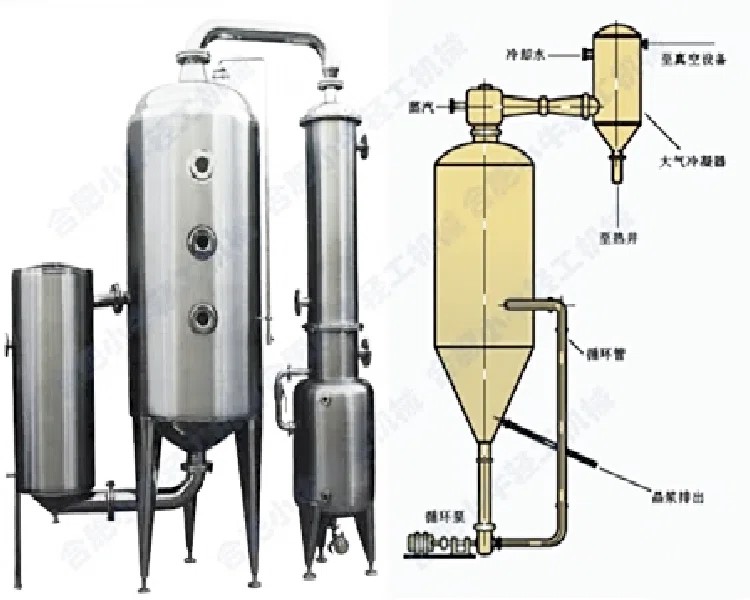
The single-effect evaporation system mainly consists of the following components:
1. Preheater and heater
In most cases, the solution to be evaporated is preheated before entering the heating chamber and then heated to the boiling point. This is usually done using a plate heat exchanger or a straight tube heater.
2. Evaporator
Select an appropriate evaporator based on material characteristics and process requirements. Commonly used evaporators include falling film evaporators, rising film evaporators, forced circulation evaporators, etc. The selection depends on the special application and product properties.
3. Separator
Each evaporator is equipped with a separator for separation of vapor and liquid. Different types of separators are selected according to the usage requirements, such as centrifugal separators, gravity separators, or separators equipped with internal components. Factors such as separation efficiency, pressure drop and cleaning frequency need to be considered during design.
4. Condenser
The steam generated during the evaporation process is usually used to heat the lower-efficiency evaporator, or as a heater to preheat materials, or the steam is recompressed and used as a heating medium. However, the final residual steam of the evaporation device cannot be used in this way and must be condensed. Evaporation units can be equipped with surface condensers, contact condensers or air-cooled condensers.
5. Degassing/vacuum system
Use a vacuum pump to maintain the vacuum in the evaporation device and remove leaking air and non-condensable gases, as well as dissolved gases in the liquid, from the system. Corresponding jet pumps and liquid ring pumps can be used according to the size and operation mode of the evaporation device.
6. Feeding pump
The selection of the feed pump is based on the characteristics of the material liquid in the evaporation system, the suction pressure, flow rate and compression ratio. For low-viscosity materials, centrifugal pumps are mainly used; for high-viscosity materials, volumetric pumps are required; for materials containing solids or crystals, other types of pumps, such as propeller pumps, should be used. The type, size, speed, sealing and material requirements of the pump are determined according to the specific application and usage conditions.
7.Cleaning system
After the equipment has been operated for a long time, scaling may occur. Chemical cleaning can be used to remove scale and other dirt. To this end, the evaporation system needs to be equipped with necessary equipment components such as cleaning agent tanks, additional pumps and pipeline valves. These equipment must ensure that they can be cleaned without disassembly, which is called "cleaning in place" (CIP). When cleaning, the cleaning agent should be penetrated into the crust layer according to the type of scaling to dissolve or decompose the crust, and the evaporator surface should be thoroughly cleaned.
8. Steam scrubber
If the evaporation device does not use raw steam for heating, but uses waste heat steam for heating. In order to prevent these steams from contaminating the heating chamber of the evaporation device or causing scaling, they must be filtered or cleaned before entering.
9. Condensate polishing system
When the quality of the condensate does not meet the requirements, such as when the product contains volatile components, the condensate needs to be further purified through a distillation tower or membrane filtration system.
10.Material requirements
The materials used in the evaporation device are determined based on product characteristics and process requirements. In most cases, stainless steel is used. Hastelloy, titanium, nickel, copper, graphite, steel lined with rubber, or other synthetic materials can be used for special needs.
Design and selection
When designing an evaporation device, a variety of factors must be considered, and these factors interact with each other and determine the type, layout, process and production costs of the evaporator. The main factors are as follows:
1. Production capacity and process parameters: material and liquid processing volume, concentration, temperature, annual production time, operating methods, product replacement, control methods, etc.
2. Material characteristics: heat sensitivity, viscosity, fluidity, foaming degree, scaling and sedimentation properties, boiling point, etc.
3. Utilities: steam, cooling water, electricity, cleaning agents, wearing parts, etc.
4. Material selection and surface polishing requirements.
5. Investment scale, capital recovery and operating costs.
6. Personnel costs for operation and maintenance.
7. On-site conditions: on-site space, climate conditions of outdoor installation, product energy loss, and production of working platforms, etc.
8. Mandatory regulations: employee health, production safety, accident prevention, noise, environmental protection, etc.
Hot Tags: Single-effect concentration evaporation system Single-effect concentration evaporation device Single effect evaporator